EchoGraphs
Light-weight spatio-temporal graphs for segmentation and ejection fraction prediction in cardiac ultrasound
Abstract
Motivation
Accurate and consistent predictions of echocardiography parameters are important for cardiovascular diagnosis and treatment. In particular, segmentations of the left ventricle can be used to derive ventricular volume, ejection fraction (EF) and other relevant measurements.
Summary
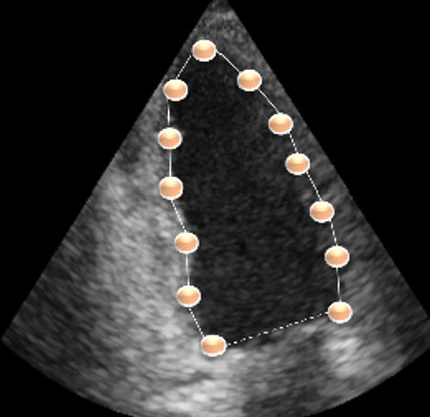
In this paper we propose a new automated method called EchoGraphs for predicting ejection fraction and segmenting the left ventricle by detecting anatomical keypoints. Models for direct coordinate regression based on Graph Convolutional Networks (GCNs) are used to detect the keypoints. GCNs can learn to represent the cardiac shape based on local appearance of each keypoint, as well as global spatial and temporal structures of all keypoints combined.
Results
We evaluate our EchoGraphs model on the EchoNet benchmark dataset. Compared to semantic segmentation, GCNs show accurate segmentation and improvements in robustness and inference run-time. EF is computed simultaneously to segmentations and our method also obtains state-of-the-art ejection fraction estimation.
Article
The paper is accepted for publication in the 2022 International Conference on Medical Image Computing and Computer Assisted Intervention. A pre-print is available on arXiv here.
If you find the work interesting, please cite it:
Citation:
S. Thomas, A. Gilbert, and G. Ben-Yosef, “Light-weight spatio-temporal graphs for segmentation and ejection fraction prediction in cardiac ultrasound”, International Conference on Medical Image Computing and Computer-Assisted Intervention. Springer, Cham, 2022.
Data
The paper relied on the EchoNet dataset which is available from Stanford here. We would like to thank the authors (Ouyang et. al, 2020) for making these resources available.
Code
The code is available on GitHub
Authors
Authors: Sarina Thomas1, Andrew Gilbert2, and Guy Ben-Yosef3,*
1: University of Oslo, Oslo, NO
2: GE Vingmed Ultrasound, Oslo, NO
3: GE Research, Niskayuna, New York, USA
*: Corresponding author: guy.ben-yosef@ge.com